
Telescopic Automatic Sliding Doors: Layout and Operator Selection
 11/08/2026, 05:13 AM
Telescopic automatic sliding doors use moving leaves on parallel tracks so that the leaves overlap when open. For door manufacturers and system integrators, the purchasing decision starts with the required clear opening and the space available to park the leaves. The operator is one part of that coordinated door assembly.
This guide helps you prepare a layout and compare operator proposals. PTADOOR supplies door operators and related system components; confirm the exact supply list for your project rather than assuming that a quotation includes finished door leaves, frames or installation.
1. Check the opening and parking layout first
A telescopic arrangement can be useful when a conventional sliding leaf has insufficient space to park beside the opening. Several narrower leaves can overlap on separate tracks. The usable opening still depends on the actual frame, overlap, handles, stops and parking arrangement: it cannot be established from the wall opening alone.
| Layout | Movement to show on the drawing | Purchasing check |
|---|---|---|
| Single-direction telescopic | Two or more moving leaves stack toward one side. | Identify the clear passage, parking space and travel of every leaf. |
| Bi-parting telescopic | Groups of moving leaves open toward opposite sides. | Show the centre meeting line and the parking space on both sides. |
| Conventional bi-parting sliding | One moving leaf travels to each side. | Check whether the required passage can already be achieved without telescopic stacking. |
Count moving leaves separately from fixed sidelights. A description such as “four-panel door” is insufficient if the supplier cannot tell which panels move. Provide a top view showing the fully closed and fully open positions, plus a section through the head track and floor guide.
2. Separate manual linkage from powered operation
A telescopic track kit may mechanically link several leaves while still being operated by hand. Do not assume that a listing for telescopic hardware includes a motor, controller or automatic activation. Ask the supplier to identify the drive method and list every component needed for the proposed operation.
In a mechanically linked powered system, the operator moves leaves through a defined transmission arrangement. In a system with independently driven tracks, control coordination is part of the design. Compare the complete proposed arrangement rather than treating these approaches as interchangeable kits.
| Question | Mechanically linked proposal | Independent-drive proposal |
|---|---|---|
| How does each leaf move? | Request the linkage layout, connection points and specified travel relationship. | Request the drive allocation, controller arrangement and required movement sequence. |
| What happens during adjustment? | Identify the adjustment method for the transmission and linked leaves. | Identify the commissioning procedure for the coordinated tracks. |
| What happens if movement is interrupted? | Ask how the assembly responds and how it is returned to service. | Ask how interrupted or unequal leaf movement is detected and recovered. |
| What must remain accessible? | Show access to the operator and linkage components. | Show access to each drive, controls and connections. |
3. Match the operator to each leaf and the supporting structure
Record the finished mass, width, height and material of every moving leaf, including its fittings. State whether a quoted capacity applies to one leaf, one drive or the complete assembly. A total doorway weight does not establish that each individual track and hanger is suitable.
The proposal should also identify the load path into the building, track spacing, hanger and guide compatibility, headroom and service access. Send the profile sections and intended mounting arrangement before ordering. A compact operator housing does not by itself establish that the complete telescopic layout fits the available recess.
4. Define controls and the intended operating conditions
Describe how users will activate the door and which access-control, locking or building-system connections are required. Ask the supplier and installer to document their compatibility, the intended sequence and the arrangements for loss of power, emergency operation and commissioning.
Overlapping leaves create areas that need attention during the complete door-system assessment. Activation devices, protective devices, operating settings and the installed layout must be considered together. Request the evidence applicable to the actual configuration and destination market; a component specification should not be treated as approval of the finished installation.
5. Where PTADOOR CF-H fits in the selection process
The CF-H linkage magnetic door operator is listed by PTADOOR with multi-track independent drive and single-opening, double-opening and linkage configurations. This makes it a candidate to discuss for coordinated multi-leaf projects.
Send your proposed telescopic arrangement for confirmation before selecting it. The published multi-track description does not by itself confirm a particular number of moving leaves, travel sequence, track spacing or finished-door performance. Request the approved configuration and component list for your drawing. Do not apply another manufacturer's telescopic layout or performance figures to CF-H.
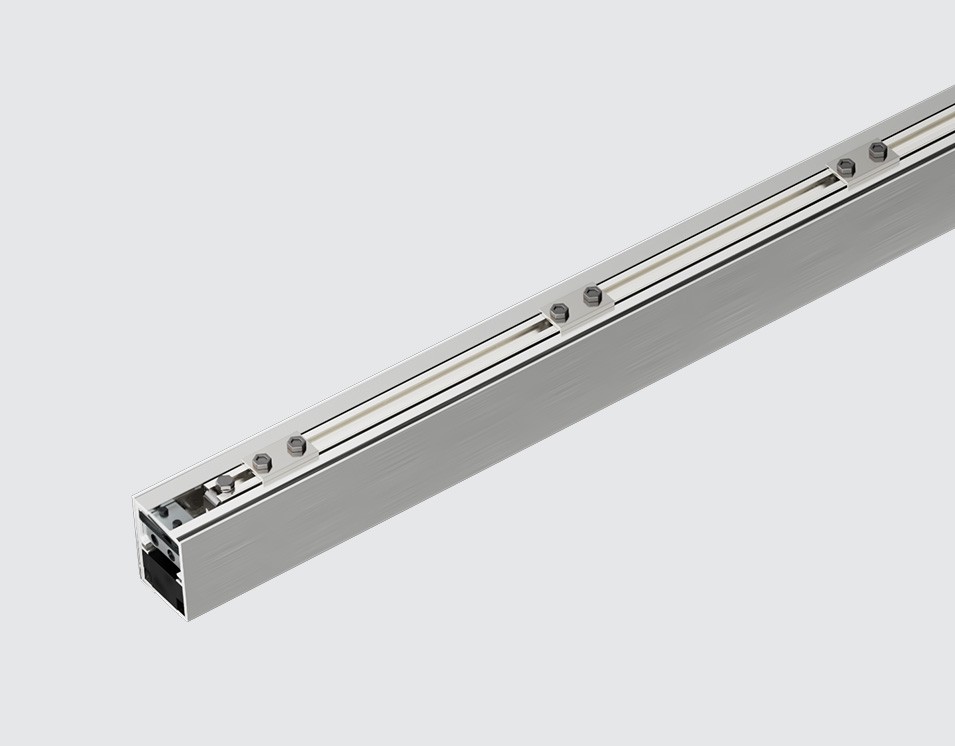
CF-H product catalogue image. The track arrangement and complete door assembly must be specified for the project.
6. Send these details for an operator quotation
- Opening drawing: wall opening, required clear passage and available parking space on each side.
- Leaf schedule: number of moving and fixed leaves, finished dimensions, mass and material of each moving leaf.
- Movement drawing: top views in the open and closed positions, with direction and travel marked for each leaf.
- Construction details: profiles, track and guide sections, mounting surfaces, headroom and maintenance access.
- Operating requirements: intended location, use pattern, activation, locks, access control and required behaviour during a power interruption.
- Supply boundaries: identify who supplies drives, controls, rails, hangers, guides, sensors, wiring, leaves and frames, and who commissions the complete assembly.
- Project and purchasing details: destination market, required project documentation, quantity and planned installation schedule.
Send your layout and leaf schedule to PTADOOR to discuss the operator configuration and quotation scope. If a conventional sliding arrangement is sufficient, start with the operator product range and specify that layout clearly.
Frequently asked questions
Are telescopic sliding doors always automatic?
No. Telescopic describes the overlapping arrangement of the leaves. Some track systems are manually operated. A powered proposal should identify the motor, controller, transmission or coordinated drives, and the required activation and protective devices.
Does a telescopic door always provide a fixed percentage of extra opening?
No universal percentage should be assumed. Compare the clear passage in the proposed drawing with the alternative layout, using the same opening and parking constraints. Manufacturer examples apply to their stated configurations.
Can an existing sliding-door operator be reused?
Compatibility needs confirmation. Provide the existing operator model, track and hanger details, leaf information and proposed movement drawing. Do not add leaves or a linkage based only on an operator's headline weight rating.