
Frameless Automatic Sliding Glass Doors: Operator and Hanger Selection
 11/12/2026, 03:28 AM
Frameless automatic sliding glass doors need an operator and a door-to-hanger connection that have been reviewed for the same glass leaf. Selecting a compact drive is only part of that decision. The glass specification, fixing detail, bottom guide and space above the opening also affect what can be assembled and serviced.
For door manufacturers, glass-door fabricators and system integrators, the useful starting point is a coordinated drawing package. This guide focuses on the connection between the glass and the operator. It does not assume that an operator quotation includes the glass, that every glass hanger fits the same leaf, or that a magnetic drive removes the need for supporting hardware.
Define what “frameless” means in the proposed door
A frameless appearance can be achieved with different arrangements. The glass may connect to individual fittings, use a continuous top rail, or sit within a detail that is partly concealed above the opening. These alternatives leave different visible fittings and require different connection drawings.
Mark which elements must remain visible and which may be concealed. Include the moving leaf, adjacent fixed glazing, head support and floor finish in the elevation and section. A photograph of the desired appearance helps communicate the design intent, but it does not replace the fixing detail needed to select the hardware.
Also separate the finished-door purchase from the automation purchase. If the glass and its fabrication are supplied locally, state that in the enquiry. Ask the operator supplier to identify the connection information needed by the glass fabricator before either party finalises its work.
Confirm the glass specification before releasing fabrication
Give the supplier the proposed glass construction, thickness, finished dimensions and complete moving-leaf weight. Identify whether those details are confirmed or provisional. The selected hanger or top connection must be reviewed against that exact specification, rather than chosen only because its photograph looks suitable.
Ask whether the proposed fitting requires holes, cut-outs, a prepared top edge, a rail or another fixing arrangement. Obtain the approved fabrication drawing for the selected fitting before releasing the glass for manufacture. Do not assume that an existing finished leaf can accept a different fitting without a fresh assessment by the responsible parties.
| Detail to agree | Information needed | Confirmation to request |
|---|---|---|
| Glass leaf | Construction, thickness, finished size and moving weight | Suitability of the proposed hanger or top connection |
| Fixing preparation | Selected fitting and its current drawing | Required preparation, dimensions and drawing revision |
| Visible finish | Exposed fittings, top rail and permitted cover line | Actual appearance of the selected assembly |
| Adjacent glazing | Fixed panels, moving path and finished clearances | Coordination of the guide, leaf path and surrounding construction |
Match the hanger, track and bottom guide as one assembly
The operator provides the driving action; the mechanical assembly must also support and guide the leaf. Review the load path from the glass connection through the hanger and track to the supporting structure. Ask which party confirms the suitability of each interface in the proposed installation.
A magnetic linear drive does not establish how the glass is carried. Likewise, a glass clamp or hanger is not automatically compatible with every trolley or track. Confirm the connection geometry, adjustment arrangement and applicable configuration with the supplier.
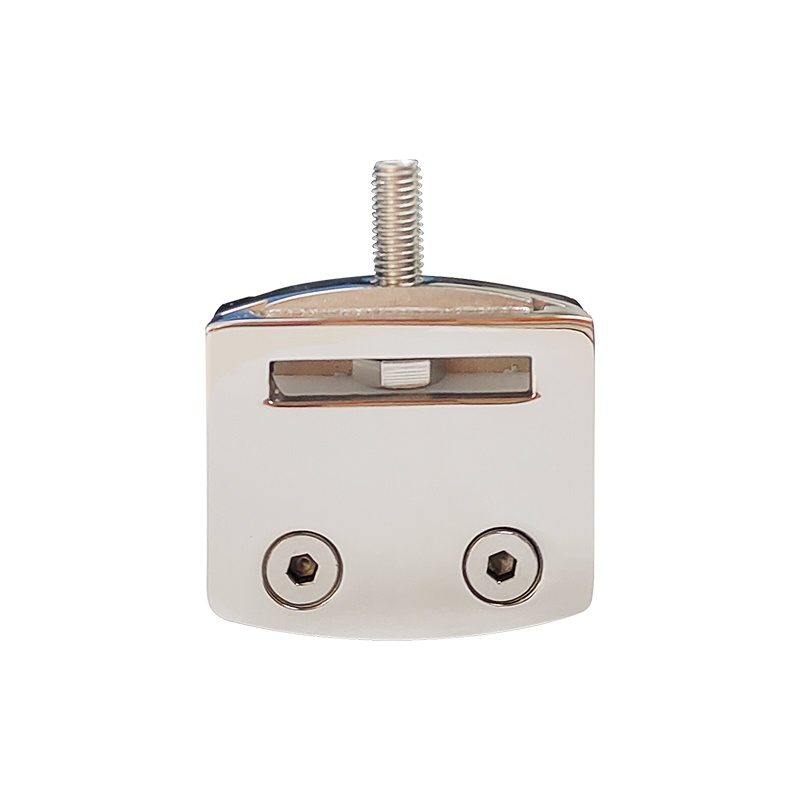
Glass-door hanger shown in PTADOOR’s CF-E catalogue. Confirm the fitting and glass specification for the proposed assembly; this image is not a universal compatibility statement.
The bottom guide deserves its own detail. Show its position relative to the glass, finished floor and opening layout. Coordinate it with the proposed leaf connection and travel rather than treating it as an interchangeable final accessory.
Check the head section and removal route
Draw the complete space above the glass, including the track, hangers, operator, covers and supporting construction. The visible glass line and the space required for the mechanism are different dimensions. Where the architectural design also uses a narrow surrounding profile, the slim-profile operator guide explains the wider head-space checks.
Establish how the installer will reach adjustment points and replace a fitting or controller. Record which cover can be removed and whether adjacent glazing or ceiling finishes obstruct access. Confirm the servicing sequence for the actual assembly before those finishes are completed.
Specify the opening layout and control requirements
Provide a plan showing each moving and fixed panel in both open and closed positions. Record the required clear opening, leaf travel and intended direction of movement. A single sliding leaf and a pair opening in opposite directions should not be described by the same opening-width figure alone.
State how the door should be activated and any access-control, locking or power-interruption requirements. Ask the supplier and responsible installer to identify the protective devices, operating settings and project documentation needed for that installation. A product accessory list does not prove that every device is included or that the complete door has been assessed for its intended use.
Keep the quotation tied to the selected glass assembly
Request a quotation that names the operator configuration and the matching glass connection. Ask for the supplied and buyer-supplied parts to be separated, including the glass, fabrication, hangers, track, guides, covers, controls and installation work. Keep the drawing revision on the quotation consistent with the drawings approved for the sample or project.
PTADOOR’s CF-E operator catalogue includes glass-door hanger references that can start this discussion. Confirm the exact configuration and supply scope with PTADOOR rather than treating every accessory shown on the page as included. The quotation comparison checklist can be used to record the agreed items and unresolved interfaces.
Send a glass-door integration enquiry
A reviewable enquiry includes the application and destination, glass specification and leaf weight, opening plan, head section, proposed fitting or top-rail detail, bottom-guide arrangement and requested control behaviour. Add the intended quantity and identify who supplies the glass and its fabrication.
Send the drawings and glass-door requirements to PTADOOR and request a configuration review. Before approving production quantities, agree on a representative sample assembly and record the outstanding interface checks. A confirmed sample and matched drawings provide a clearer ordering basis than a request for a “frameless automatic door motor” alone.
Frequently asked questions
Can the operator be selected from the glass thickness alone?
No. Thickness is one input to the fitting review. The leaf size and weight, glass construction, connection detail, supporting assembly and required movement also need confirmation for the proposed configuration.
Does a frameless design mean that no top rail is used?
No. Different designs use different top connections. Confirm the actual visible fittings and head section instead of inferring the assembly from the word “frameless”.
Can a finished manual glass door always be automated?
That requires a separate review. The existing glass preparation, supporting hardware, head space and guide arrangement may limit the available options. Ask for the actual assembly to be assessed before ordering an operator or changing the glass hardware.