
Bi-Parting Automatic Sliding Doors: Drive Coordination and Leaf Loads
 11/13/2026, 12:27 PM
In a conventional bi-parting automatic sliding door, two moving leaves meet at the centre and slide away in opposite directions. For a door manufacturer or integration team, the buying decision is more specific than choosing a “double door motor”: the proposal must explain how both leaves move, what each leaf weighs and how the complete assembly is coordinated.
This guide focuses on the operator and its interfaces. Door leaves, frames, running gear and installation responsibilities should be identified separately in the proposed supply.
Two moving leaves, one clear passage
Mark the centre meeting line on the front elevation. Identify the left and right moving leaves and the space each occupies when fully open. A two-panel arrangement in which both panels travel toward the same side is a different layout; “two leaves” alone does not describe their movement.
A telescopic system can have more than one moving leaf stacking on each side. If that is your proposed arrangement, use the separate telescopic sliding-door layout guide. The checks below concern a conventional centre-opening pair.
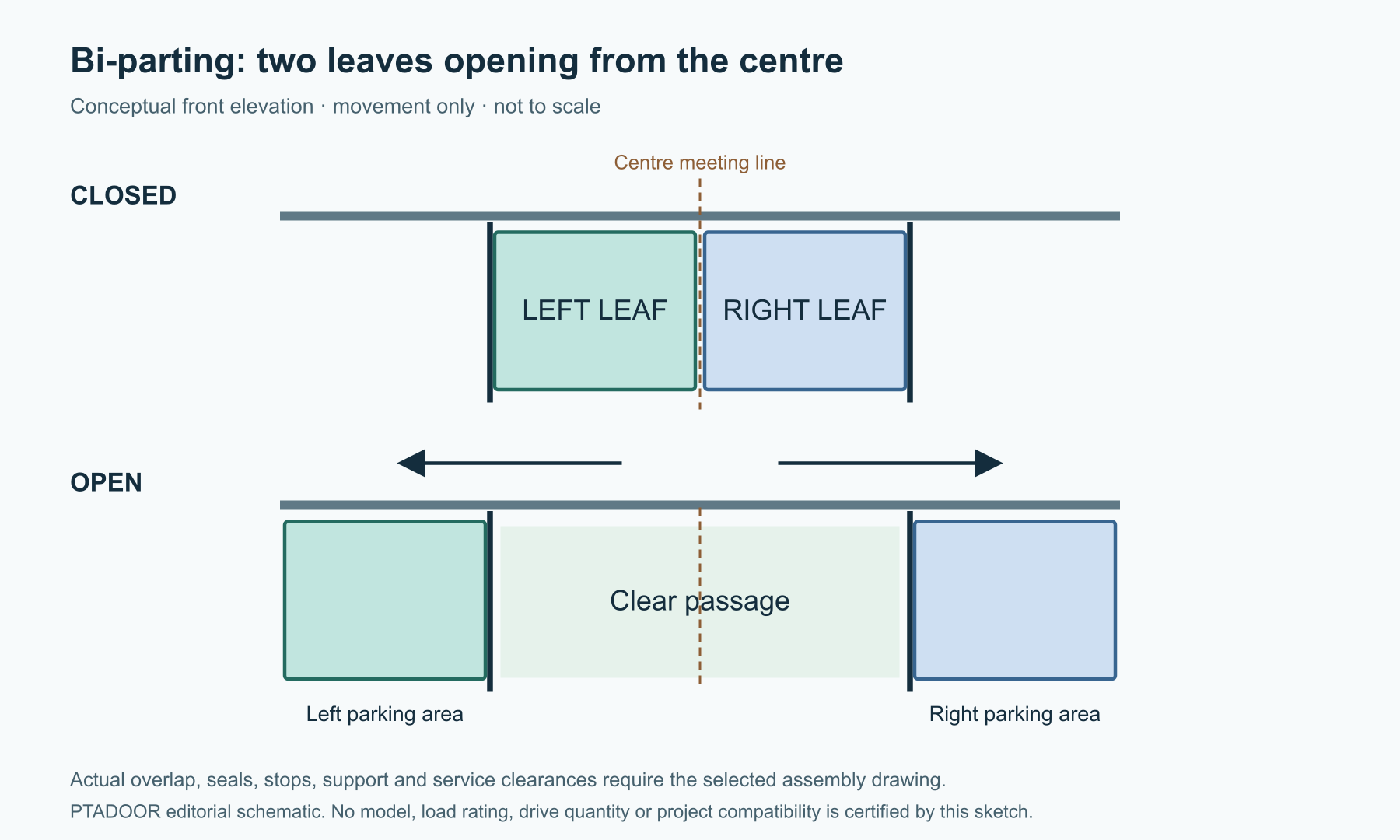
Conceptual movement schematic, not to scale; not a model assembly, installation drawing, tested configuration or customer project.
Confirm the proposed drive and coordination arrangement
A bi-parting layout does not, by itself, specify the number of motors. Different operator designs coordinate the two leaves in different ways.
| Arrangement in the proposal | What the buyer should be able to identify |
|---|---|
| A drive assembly with a mechanical transmission to both leaves | The transmission, attachment of each leaf and the applicable single- and double-leaf configuration limits. |
| Electronically coordinated drive assemblies | The drive assigned to each leaf, the specified coordination connection, the controller arrangement and the commissioning procedure. |
| A quotation that says only “double opening” | A configuration drawing and a defined supply list before treating it as a complete solution. |
Two standalone operators receiving an opening command are not automatically a specified coordinated system. The supplier should explain the intended movement, centre meeting and response of the combined assembly using the documentation for that configuration. Do not substitute an assumed wiring arrangement for that information.
Keep a separate record for each door leaf
Record the dimensions and complete moving mass of the left and right leaves separately, including their actual profiles, glass or panel construction, handles and attached fittings. Where values are estimates, mark them as estimates.
A total weight for the pair can hide an unequal load. Likewise, a catalogue rating for a single sliding leaf should not simply be doubled or divided by two to approve a bi-parting assembly. Obtain the limits for the selected double-leaf configuration and confirm how the quoted figures apply to each moving leaf and the complete assembly.
| Leaf record | Left leaf | Right leaf |
|---|---|---|
| Drawing reference and revision | Identify separately | Identify separately |
| Complete moving mass | Measured, calculated or estimated | Measured, calculated or estimated |
| Closed and fully open positions | Mark on the layout | Mark on the layout |
| Proposed drive and running gear | Match to the quotation | Match to the quotation |
Check the meeting line and both parking areas
The visible opening in the wall is not the same as the finished clear passage. Frame sections, overlap, seals, handles and stops affect the final arrangement. Show both fully closed and fully open positions, together with the supporting track, bottom guidance and the access needed to remove or service the equipment.
If the leaves have different widths or travel distances, identify that difference before operator selection. The proposed coordination must suit the actual pair; a centre-opening sketch is not approval for any particular unequal-leaf configuration.
An opening-layout sketch explains the intended movement. It does not replace the product assembly or installation drawing for the selected operator.
Keep the controls tied to the selected assembly
Define the required activation, operating modes, detection devices and locking arrangement with the operator supplier and the responsible door-system specialist. The proposal should identify how those items connect to the coordinated pair and which documents and acceptance checks apply to the finished door. A catalogue accessory image does not establish that the accessory is included or compatible with every controller.
Discuss a PTADOOR double-opening configuration
The CF-F40 magnetic sliding-door operator is listed for single-opening, double-opening and linked arrangements. Use that as a starting point for a configuration review, rather than as approval for an existing door or an assumed number of drive units.
Send a marked front elevation, the record for each moving leaf, the available operator section and the requested quantity. Ask PTADOOR to return a proposal identifying the drive and control arrangement, included components, drawing revision and items still to be confirmed. Request a bi-parting operator configuration review.
Frequently asked questions
Is a bi-parting door the same as a telescopic door?
Bi-parting describes movement away from a centre meeting line. Telescopic describes leaves stacking along a side. A telescopic system can also open in two directions, so the drawing must identify both the opening direction and the stacking arrangement.
Does a bi-parting operator always require two motors?
No. The operator architecture determines how the leaves are driven and coordinated. Confirm the actual configuration rather than inferring the motor quantity from the number of leaves.
Can two leaves with different weights use the same quoted limit?
Confirm each leaf against the supplier's limits for the proposed assembly. Do not use a pair's total weight or a single-leaf catalogue figure as approval for both leaves.

