
Soft-Close, Self-Closing or Automatic Sliding Doors: Which Do You Need?
 11/16/2026, 03:43 PM
A project brief that asks for an “automatic closing sliding door” can describe several different requirements. A user may want a door that slows before reaching its end position, returns to closed after someone opens it, or opens and closes under powered control. Those requests should be separated before selecting hardware or a drive.
For an office partition, for example, gentle closing does not necessarily remove the need to open the door by hand. Returning to closed does not necessarily provide touch-free opening. Write down the required opening action and closing action separately, then confirm how the proposed configuration delivers them.
What soft-close hardware does
Soft-close hardware controls movement as the door approaches a specified position. The supplier should identify its engagement range, the compatible track and door hardware, and the direction in which it works. The name alone does not establish that the system powers the entire opening or closing movement.
A soft-close pocket-door accessory may therefore answer a different purchasing need from a powered sliding-door operator. Check whether the quotation covers an accessory for an existing track or a complete compatible hardware arrangement. A soft-close label also does not establish the presence of presence-detection devices or a particular safety performance.
What a self-closing mechanism does
A self-closing mechanism returns a door towards its closed position after opening, within the conditions stated for the selected product. Confirm how the user opens the door, whether a hold-open option is available, and whether the return action also needs a separate damping accessory.
Self-closing and soft-close functions can be combined in some systems. They are not necessarily competing choices. Compatibility still needs to be checked against the exact pocket frame, track, door panel and accessories; an existing opening does not automatically accept a different mechanism.
What a powered automatic sliding-door system adds
A powered system drives door movement according to its selected controls and operating modes. The opening input might be a push button, sensor or another interface, depending on the configuration. Describe the required input explicitly instead of assuming that “automatic” always means touch-free.
The activation checklist helps separate opening inputs from other control requirements. Detection devices, closing logic, hold-open behaviour and the response to a power interruption also need confirmation for the proposed installation. This article does not specify a safety design or an emergency-exit configuration.
Compare the required actions before comparing products
| Requirement | Soft-close hardware | Self-closing mechanism | Powered automatic system |
|---|---|---|---|
| Main task to confirm | Control movement near a specified end position | Return the door towards closed | Drive opening and closing under selected controls |
| Opening action | Confirm the manual or combined arrangement | Confirm how the user opens the door | Specify the opening input and operating mode |
| Gentle closing | Confirm the accessory and its working range | Confirm whether damping is included or separate | Confirm the configured motion and supporting hardware |
| Hold-open requirement | Check the complete arrangement | Check compatibility with the return mechanism | Confirm the control logic and any fitted interfaces |
| Supply boundary | Accessory, track or combined hardware package | Return mechanism and compatible hardware | Drive components, operator kit or wider door-system scope |
Use this table to record questions, not as a universal specification for any manufacturer’s product. A door may combine more than one function.
When to consider a magnetic linear drive
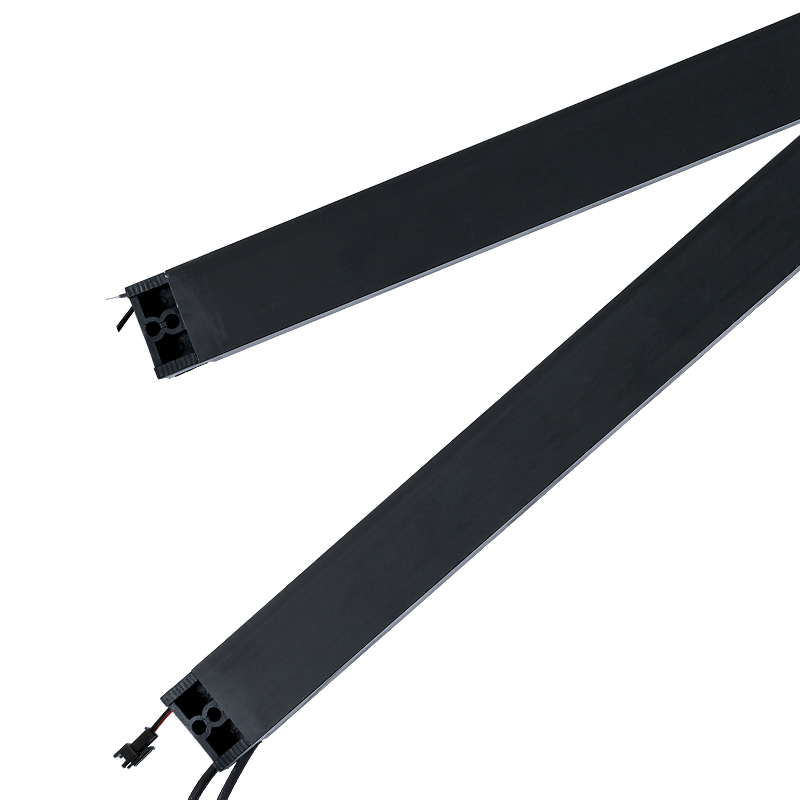
PTADOOR CF-40 magnetic linear drive components, shown as an example of a powered-drive product. This photograph does not represent a mechanical soft-close accessory, a self-closing mechanism or a complete door.
Consider a magnetic linear drive when the project calls for powered movement and a suitable integration can be confirmed. The drive technology does not by itself define the opening input, the detection equipment, the supporting hardware or the power-loss behaviour of the finished door.
The CF and QT selection guide discusses drive choices. The CF-40 component reference identifies a magnetic linear drive product for a configuration review; it should not be treated as a quotation for a complete door. A mechanical soft-close accessory and a powered drive should be compared against the required actions and supply scope before comparing their prices.
Send suppliers a functional brief
Provide the opening layout and available integration space, then complete the following brief. Include drawings where available and identify which parts the door manufacturer or installer already supplies.
| Item | Project requirement | Supplier confirmation |
|---|---|---|
| Opening action | Manual, button, sensor or other specified input | Proposed input and included parts |
| Closing action | Gentle finish, return to closed, powered closing or combination | How each action is delivered |
| Hold-open | Required situations and user control | Supported arrangement and limits |
| Door and hardware | Panel details, layout and existing hardware | Compatibility and supporting components |
| Detection and interfaces | Project-specific requirements | Devices, interfaces and scope to be confirmed |
| Power interruption | Required behaviour | Documented behaviour for the selected configuration |
| Supply and handover | Components, kit or complete system; responsible parties | Included items, exclusions and documents |
The procurement scope guide can help organise the quotation. Before handover, use the maintenance and handover guide to identify documentation and responsibilities. Service tasks and intervals must come from the applicable system documentation and installation conditions.
Frequently asked questions
Does a soft-close sliding door open automatically?
The soft-close label alone does not establish powered opening. Ask what starts the opening movement and which component supplies the force.
Can a door have both soft-close and self-closing functions?
Some systems combine them. Confirm compatibility and whether the quotation includes both functions for the exact door and hardware arrangement.
Does a magnetic sliding-door drive always include sensors?
Do not assume this from the drive description. Confirm the activation devices, detection equipment and supplied components for the selected configuration.
Send PTADOOR the required opening and closing actions, drawings and intended supply scope for a configuration review. Model selection and product-specific performance remain subject to confirmation.